

Finding Holiness in The Ordinary: Living St. Therese's Little Way
We can sometimes imagine holiness as something reserved for extraordinary people doing extraordinary things


We can sometimes imagine holiness as something reserved for extraordinary people doing extraordinary things. We picture the saints performing heroic acts of virtue, enduring great suffering, or dedicating their entire lives to some remarkable mission. And while the Church certainly gives us saints whose lives were marked by extraordinary deeds, there is another path to holiness that is much quieter.
St. Thérèse of Lisieux called it her “little way.”
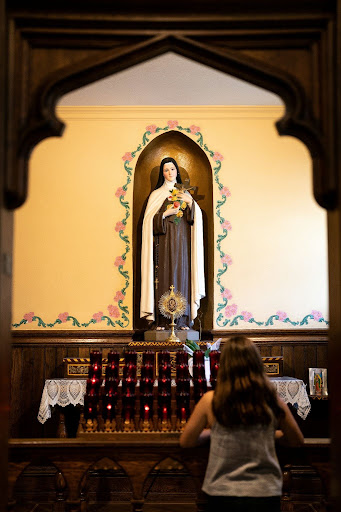
Thérèse did not become a saint by accomplishing great things in the eyes of the world. She entered the Carmelite convent at the age of fifteen and lived a hidden life within its walls until her death at just twenty-four. Yet she came to understand that this hidden, ordinary life could become a path to profound holiness.
The Little Way is not simply about doing small things. At its heart, it is a way of approaching God: with the trust of a child, with confidence in His mercy, and with a willingness to offer Him even the smallest acts of our daily lives.
As Thérèse wrote in Story of a Soul, she longed to become a saint but felt the distance between herself and the great saints was enormous. Rather than allowing her littleness to discourage her, she began searching for another way to God. She wrote that she wanted “a little way—very short and very straight” because she was too small to climb the “steep stairway of perfection.” She eventually found her answer in Scripture, particularly in the words, “Whosoever is a little one, let him come to Me.”
Her answer was not to try harder to become impressive. It was to become little—to recognize her dependence upon God and allow herself to be carried by His grace.
So how can we live the Little Way in our own ordinary lives?
1. Begin with trust in God
The Little Way begins with spiritual childhood.
For Thérèse, being “little” did not mean being immature or careless about the spiritual life. It meant knowing that she could not make herself holy by her own strength. She needed God.
She compared herself to a small child who wants to climb a staircase but is unable to make it up the steps. In another passage, she described the arms of Jesus as the “lift” that would carry her to Heaven. Her task was not to somehow become big enough to reach God on her own, but to trust Him enough to let Him carry her.
This is an important starting point for the Little Way because it changes the way we think about our own weakness.
We can be tempted to become discouraged by the gap between the person we are and the person we want to be. We know we should be more patient, more generous, more prayerful, less distracted, less selfish. We make resolutions and then fail to keep them. We lose our temper. We become impatient. We fall into the same faults again.
The response of the Little Way is not indifference toward sin. Thérèse wanted holiness very much. But she also refused to become discouraged by her littleness.
Instead, she trusted in God's mercy.
When you fail, begin again. Ask for forgiveness. Accept God's grace. Take the next small step.
Holiness does not require pretending that we are already saints. It requires allowing God to work in us precisely where we are.
2. Offer God the small things
Thérèse understood that love could be expressed through the smallest actions.
She spoke of offering Jesus the “flowers” of little sacrifices. For her, these sacrifices were not necessarily dramatic acts of penance. They could be the small opportunities for self-denial and love that appear throughout an ordinary day.
In one passage, she describes looking for little opportunities to please Jesus when she was experiencing spiritual dryness. A smile or a kind word when she would rather remain silent could become an offering. If no particular opportunity presented itself, she would simply repeat that she loved Jesus.
This is where the Little Way becomes very practical.
A mother can offer God the patience required to answer the same question for the fifth time.
A father can offer the inconvenience of stopping what he is doing to help someone.
A student can offer the effort of doing a difficult assignment well.
A coworker can choose a kind response instead of an irritated one.
Anyone can perform a task that needs to be done without needing anyone else to notice.
None of these things will look particularly impressive from the outside. That is precisely the point.
The Little Way teaches us to stop measuring the spiritual value of an action by how important it appears. A small act done with love can become an offering to God.
3. Accept the ordinary annoyances of life
Some of our greatest opportunities for holiness are found in the circumstances we would never have chosen for ourselves like interruptions that disrupt our plans, inconveniences that test our patience, and the people whose habits or personalities rub us the wrong way.
Thérèse gives a particularly memorable example from her life in Carmel. One of the sisters had a habit that irritated her; during prayer, Thérèse could hear the continual clicking of the sister's little rosary. Instead of allowing her irritation to grow, she chose to bear it patiently and even came to see the noise as a kind of music she could offer to Jesus.
The incident was small. But for Thérèse, these small circumstances were precisely where love could be practiced.
This is one of the most challenging aspects of the Little Way because we often want holiness to happen on our terms. We might be willing to make a great sacrifice if we can choose the sacrifice ourselves. But the Little Way asks us to pay attention to the opportunities God has already placed in front of us.
Instead of asking only, “How can I get through this?” we can begin asking, “How can I love God and my neighbor in this?”
4. Let ordinary work become an act of love
One of the beautiful things about the Little Way is that it does not require us to escape ordinary life. Thérèse did not need to become famous or accomplish something spectacular in order to become holy. Her life was largely hidden within the walls of the Carmelite convent, yet she discovered that even the smallest duties and sacrifices could become opportunities to love God.
The same is true for us. Much of our lives is made up of things that can feel spiritually insignificant precisely because they are so familiar: cooking dinner, folding laundry, going to work, caring for children, studying, or simply helping someone who needs us. Yet when we approach these responsibilities with love and offer them to God, they become part of our path toward holiness.
The Little Way invites us to see that our ordinary responsibilities can become acts of love. We may never do anything that seems remarkable to the world, but we can patiently answer a child's question, complete an unpleasant task without complaining, or choose to serve someone when we would rather be left alone. These actions may go unnoticed by everyone else, but they are not unnoticed by God.
Thérèse understood that she did not have to do everything; she simply had to give God what was in front of her and do it with love. We can do the same.
5. Begin again when you fail
The Little Way does not mean that we will suddenly become perfectly patient, generous, or prayerful. Thérèse was deeply aware of her own weaknesses and imperfections, but she did not allow them to lead her into discouragement. Instead, she trusted in God's mercy and continued to turn back to Him.
This is an important part of spiritual childhood. When we lose our patience, fall into the same fault again, or fail to live up to the resolutions we have made, we can be tempted to become frustrated with ourselves. Thérèse offers another response: humility, trust, and a willingness to begin again. Our failures can remind us that holiness is not something we accomplish through our own strength. We need God's grace at every step.
Living the Little Way means learning to receive that grace with the confidence of a child. When we fall, we can ask forgiveness, entrust our weakness to God, and take the next small step toward Him. We do not have to become discouraged because we are still little. We can simply allow God to love us there and trust Him to continue His work in us.
Holiness is closer than we think
The gift of St. Thérèse's Little Way is that it reminds us we do not have to wait for extraordinary circumstances to become holy. The people we live with, the responsibilities we carry, the inconveniences we encounter, and the small acts of love we offer each day can all become opportunities to draw closer to God.
Thérèse teaches us to approach these ordinary moments with the trust of a little child: confident in God's mercy, willing to accept our littleness, and ready to offer Him whatever comes our way. The path to holiness may look very ordinary, but when our ordinary lives are placed in God's hands and lived with love, nothing is insignificant.